Members Section

Sharing Knowledge, Experience, and Innovations in Forensic PracticeWCMEA | Recent Conference Presentations

WCMEA | Recent Conference Presentations

How These Archived Presentations Support Ongoing Professional Development:

Access to archived conference content is more than just a recap—it’s a valuable tool for long-term learning, training, and implementation of best practices. By reviewing these presentations, WCMEA members can stay informed about the latest trends, regulations, and case-based approaches in the field. These resources are especially helpful for onboarding new staff, fulfilling continuing education requirements, and reinforcing consistent, statewide standards in medicolegal investigations.

Welcome to the WCMEA Conference Presentation Archive

The WCMEA 2024 Conference in Eau Claire, Wisconsin, is a three-day training event for coroners, medical examiners, and forensic professionals. From June 23–25, attendees receive focused instruction on death certification, expert testimony, Smith v. Arizona, organ donation, railroad investigations, and toxicology trends. Additional sessions cover tissue and eye donation, next-of-kin location, and forensic anthropology. The conference concludes with insights from the WiscIR Team and a case study on identifying a 1993 John Doe.

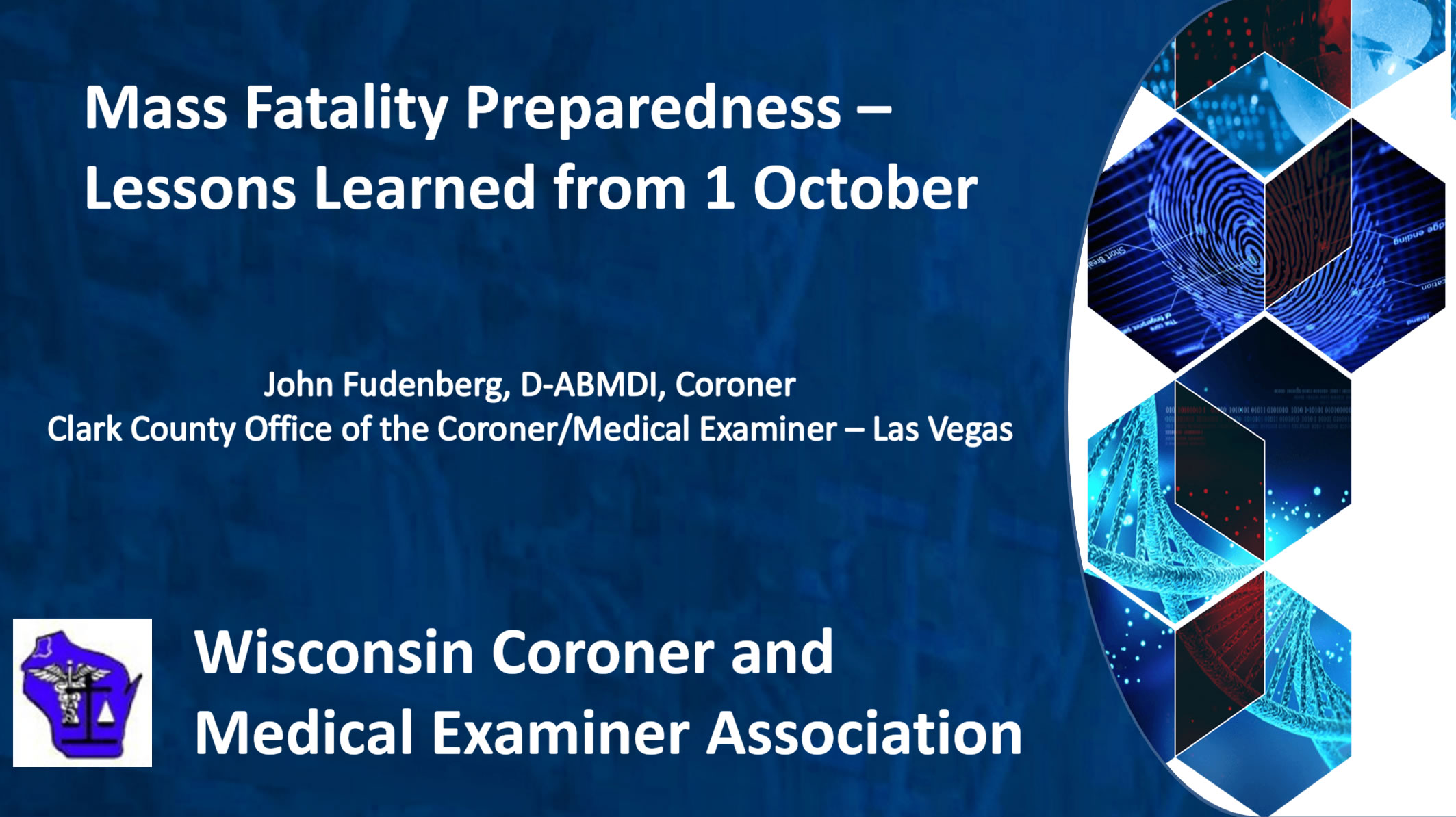
Clark County Nevada Coroner Mass Fatality Preparedness

The Clark County, Nevada Coroner’s presentation on Mass Fatality Preparedness focuses on critical lessons learned from the October 1, 2017, Route 91 Harvest Festival shooting, the deadliest mass shooting in modern U.S. history. The tragedy resulted in 58 fatalities and over 1,000 injuries after a shooter opened fire from a hotel window overlooking a concert crowd.

The presentation outlines the response of the Clark County Office of the Coroner/Medical Examiner (CCOCME), highlighting coordination with agencies such as the FBI, local hospitals, and medical examiner offices across the country. Key components included the establishment of a Missing Persons Call Center, a Family Assistance Center (FAC), and the use of UVIS software for victim identification and reunification efforts. All 58 victims were identified and families notified within 72 hours.

Staff wellness played a major role post-incident, with initiatives like trauma meditation, therapy dogs, and mental health counseling for responders. The response emphasized the importance of multi-agency coordination, robust planning, and emotional support.

The event led to the creation of the Vegas Strong Resiliency Center and inspired new legislation and studies focused on mental health and emergency response planning, reinforcing the need for preparedness in future mass fatality events.

Clark County Nevada Coroner Mass Fatality Preparedness

WFCAP Presentation January 2020

The Wisconsin Funeral and Cemetery Aids Program (WFCAP), established under Wis. Stat. § 49.785 and administered by the Department of Health Services, helps funeral homes, crematories, and cemeteries serve Medicaid-eligible decedents when other financial resources are insufficient. Eligible decedents include participants in Medicaid-related programs, and providers may request posthumous eligibility determinations.

WFCAP pays up to $1,500 for funeral/burial expenses and $1,000 for cemetery or crematory costs, acting as payer of last resort. Claims must be submitted on form F-10141 within 12 months of death and must include actual itemized charges. Special circumstances—such as oversized caskets or long-distance transport—may qualify for higher payments with proper documentation.

For deaths after October 3, 2016, life-insurance proceeds over $3,000 reduce WFCAP payments dollar-for-dollar. Providers receiving WFCAP funds are exempt from coroner and county transportation fees.

WFCAP Presentation January 2020

WI PDMP Presentation Jan. 2020

The Wisconsin Prescription Drug Monitoring Program (ePDMP), created under Wis. Stat. § 961.385, is a statewide database tracking Schedule II–V controlled-substance prescriptions. Since 2013, it has expanded to include interstate data sharing with 15 states and a public dashboard. HOPE Legislation (2015–16) required prescribers to review the PDMP before issuing monitored prescriptions, mandated dispensers to report within one business day, and allowed access for healthcare providers, law enforcement, and coroners without a court order, with limited exceptions.

Roughly 2,000 pharmacies submit about 700,000 records monthly, with five days to correct errors. From 2015–2018, opioid dispensing fell 29% and benzodiazepines 19%, while stimulant prescribing rose 6%.

Medical examiners and coroners may obtain direct PDMP access to support death investigations, receiving patient prescription histories without prescriber alerts. The ePDMP also supports law-enforcement, auditing, and public-health functions, though its data is informational and may contain inaccuracies.

WI PDMP Presentation Jan. 2020

WI Coroner ME Conference Jan 2020

John Fudenberg of the Clark County Office of the Coroner/Medical Examiner presented a detailed case study on the agency’s response to the October 1, 2017 Route 91 Harvest Festival mass shooting in Las Vegas. The 17.5-acre outdoor concert, attended by more than 22,000 people, became the site of a catastrophic attack in which the gunman fired over 1,100 rounds, killing 58 and injuring more than 1,000.

Fudenberg outlined the structure and scale of the Clark County Coroner’s Office—over 90 staff members and nearly 18,000 cases annually—and described the agency’s major response efforts: coordinated victim identification, a Missing Persons Call Center, and a Family Assistance Center to support and notify next of kin. The session emphasized staff wellness, resiliency, and lessons learned, including improved communication and preparedness for mass-fatality incidents.

(To view the presented click the image below)